Bible study guides
Free guides organized by book of the Bible, topic, and group type — plus how to pick the right one and write your own.
A good Bible study guide does three things: it keeps you in the text, it asks questions worth answering, and it ends with something you can actually do. Below are free guides sorted by book, topic, and audience, along with a four-step method for building your own guide for any passage.
What's the season you're in?
Next step
Enter any passage and instantly get an icebreaker plus nine observation, interpretation, and application questions — a complete study guide for your next meeting.
Build a study guide for any passageHow to choose the right Bible study guide
- Start with your group, not the curriculum. New believers need a Gospel; a mature group can handle Romans.
- Match the length to your commitment. A four-week study finishes; a 24-week study often does not.
- Book studies build biblical literacy. Topical studies meet an immediate need. Alternate between them.
- Pick a guide that asks more questions than it answers — discussion is where the learning sticks.
- Check that every session ends with an application step, not just information.
Guides by type of study
- Book study — work verse by verse through one book, in order, start to finish.
- Topical study — trace one theme (anxiety, forgiveness, prayer) across many passages.
- Character study — follow one person's story and what God did in and through them.
- Word study — trace a single word (grace, covenant, shalom) through the whole canon.
- Devotional study — a short daily reading with reflection and prayer.
- Inductive study — the observation, interpretation, application method applied to any passage.
Best books of the Bible to study, by level
- Brand new — Mark: the fastest Gospel, all action, 16 chapters.
- New believer — John: who Jesus is and why it matters.
- Beginner group — Philippians: joy and contentment in four chapters.
- Practical — James: faith that shows up in speech, money, and trials.
- Assurance — 1 John: how to know you belong to God.
- Story-driven — Ruth: a complete narrative of loyalty and redemption.
- Prayer — Psalms: honest language for every season.
- Wisdom — Proverbs: one chapter a day for a month.
- Doctrine — Romans: the fullest explanation of the gospel.
- Church life — Acts: how the first Christians actually lived.
Topical study guides
- Anxiety and worry — Philippians 4:4–9, Matthew 6:25–34, 1 Peter 5:6–7.
- Forgiveness — Matthew 18:21–35, Ephesians 4:32, Colossians 3:12–14.
- Prayer — the Lord's Prayer, Hannah, Daniel, and Paul's prayers.
- Identity — Ephesians 1, Romans 8, 1 Peter 2:9.
- Money and generosity — 2 Corinthians 8–9, 1 Timothy 6:6–19.
- Suffering and hope — Job, Romans 5:1–5, Romans 8:18–39.
- The armor of God — Ephesians 6:10–18, one piece per week.
- The fruit of the Spirit — Galatians 5:22–23, one fruit per week.
- Grace — Ephesians 2:1–10, Titus 2:11–14, Romans 5.
- Spiritual disciplines — Scripture, prayer, fasting, worship, service, rest.
Guides by audience
- Beginners — start with a short Gospel and three simple questions per session.
- Men's groups — character studies, integrity, work, and accountability.
- Women's groups — Ruth, Esther, Philippians, identity, and anxiety.
- Youth — Mark, Psalms, identity, and questions about doubt.
- Couples and marriage — Ephesians 5, 1 Corinthians 13, Song of Songs.
- Kids and families — Bible story arcs with one memory verse per week.
- Online groups — shorter passages, more questions, and a shared document.
- New Christians — the gospel, baptism, prayer, and the church.
Write your own guide in four steps
- 1. Read the passage three times — once for the story, once slowly, once out loud.
- 2. Observe: write down who, what, when, where, repeated words, and contrasts.
- 3. Interpret: what did this mean to the original audience, and what does it reveal about God?
- 4. Apply: write one question that forces a decision, and one action step for the week.
What every session should include
- An icebreaker tied loosely to the theme.
- The passage read aloud before anyone comments on it.
- Two or three observation questions to ground the discussion.
- One interpretation question about God's character or the gospel.
- One application question with a specific, measurable next step.
- Prayer that responds directly to the passage and to what people shared.
Common mistakes with study guides
- Using a guide that quotes the Bible less than it quotes the author.
- Choosing a study far above or below the group's level.
- Skipping context — a verse without its chapter is a proof text.
- Filling the hour with content and leaving no room for discussion.
- Never finishing. Pick shorter studies and actually complete them.
Find people near you
Reading is better with company. These finders are free and take about a minute.
Readers who loved this also grabbed

Farm & Posh Personalized NIV Bible — Crown of Thorns
Beautiful custom engraving on the cover — perfect for a baptism, confirmation, or a gift you'll actually keep. NIV translation, cross-references, words of Christ in red.
Affiliate — we may earn from qualifying purchases at no cost to you.
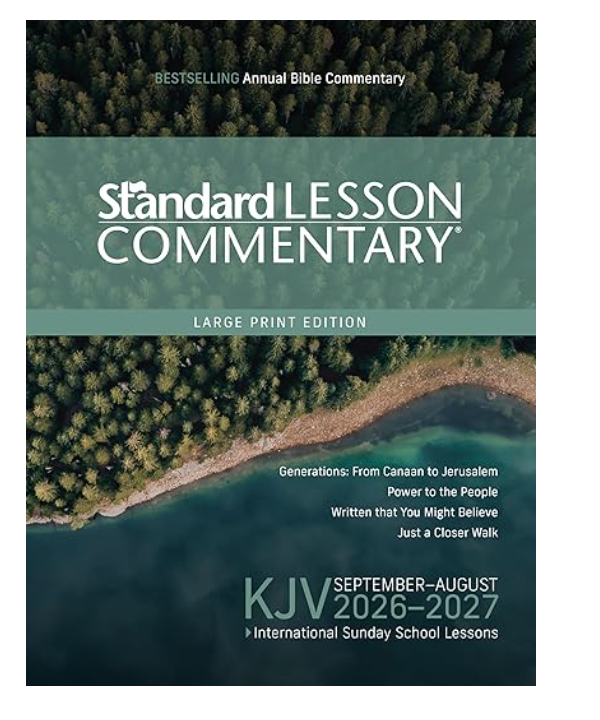
KJV Standard Lesson Commentary® 2026–2027 (Large Print)
The world's most popular annual Bible commentary, trusted for 60+ years. Printed KJV text, verse-by-verse notes, historical context, discussion questions, and group activities — 14pt large print.
Affiliate — we may earn from qualifying purchases at no cost to you.
Enter any passage and instantly get an icebreaker plus nine observation, interpretation, and application questions — a complete study guide for your next meeting.
Build a study guide for any passageBrowse all guides, free tools, or search the whole site.