Inductive Bible study, explained
The OIA method — Observation, Interpretation, Application — with the exact questions to ask in each step and a worked example.
Inductive Bible study lets the text set the agenda. Instead of starting with what you want it to say, you observe carefully, interpret in context, and only then ask how it applies to your life. It's the method that has shaped serious Bible readers for a century — and it works for a verse, a chapter, or a whole book.
What's the season you're in?
Next step
Pick a book to study inductively — we'll generate a daily plan that finishes.
Get a personalized reading planStep 1 — Observation: 'What does it say?'
- Read the passage three times slowly. Once silently, once aloud, once in another translation.
- Mark repeated words and phrases.
- Circle connecting words: therefore, but, so that, because, if, then.
- List the who, what, when, where in the margin.
- Note commands, promises, comparisons, contrasts, cause-and-effect.
Step 2 — Interpretation: 'What does it mean?'
- What did this mean to the original audience? (Check a study Bible intro.)
- How does this passage fit the chapter and book around it?
- What does the rest of Scripture say about this idea?
- What is the main point the author is making — in one sentence?
- Watch for category errors: a promise to Israel is not always a personal promise to you; a description is not always a prescription.
Step 3 — Application: 'What does it mean for me?'
- Is there a sin to confess? A command to obey?
- Is there a promise to claim? An example to follow or avoid?
- What truth about God do I need to remember this week?
- What is one specific, measurable action I'll take in the next 7 days?
- Who can I share this with so I actually do it?
Worked example — Philippians 4:4–9
Observation: Repeated word 'rejoice' (twice in verse 4). Connecting words 'do not be anxious … but … present your requests' (replacement, not just removal). Commands: rejoice, do not be anxious, pray, think on these things, put into practice. Promise: 'the peace of God … will guard your hearts.' Interpretation: Paul writes from prison. 'Rejoice always' isn't denial; it's defiance — joy as an act of faith. The structure is: do this (rejoice/pray), receive that (peace), then do this (think rightly), receive that (God's presence). Peace is both a gift and a discipline. Application: One anxious situation I'll bring to God in specific prayer this week. One 'whatever is true, noble, right' I'll meditate on instead of doom-scrolling. One person I'll text the verse to.
A weekly rhythm
- Mon–Wed — Observation (slow reading, marking).
- Thu–Fri — Interpretation (context, cross-references, main point).
- Sat — Application (one specific action).
- Sun — Share what you saw with one person or your small group.
Tools you actually need
- A printable, double-spaced copy of the passage (great for marking).
- A pen with two colors.
- A study Bible or free online commentary for context.
- A second translation for comparison.
- Twenty minutes, three to five times a week.
Find people near you
Reading is better with company. These finders are free and take about a minute.
Readers who loved this also grabbed

Farm & Posh Personalized NIV Bible — Crown of Thorns
Beautiful custom engraving on the cover — perfect for a baptism, confirmation, or a gift you'll actually keep. NIV translation, cross-references, words of Christ in red.
Affiliate — we may earn from qualifying purchases at no cost to you.
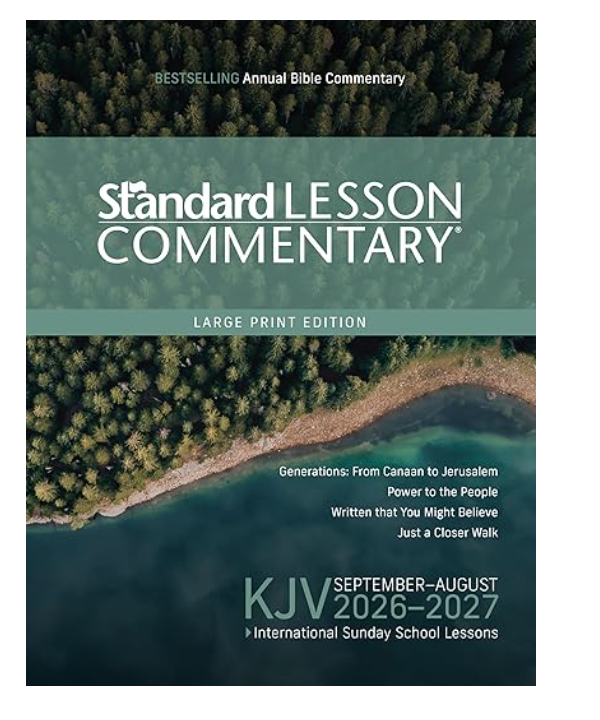
KJV Standard Lesson Commentary® 2026–2027 (Large Print)
The world's most popular annual Bible commentary, trusted for 60+ years. Printed KJV text, verse-by-verse notes, historical context, discussion questions, and group activities — 14pt large print.
Affiliate — we may earn from qualifying purchases at no cost to you.
Pick a book to study inductively — we'll generate a daily plan that finishes.
Get a personalized reading planBrowse all guides, free tools, or search the whole site.