Explained
What does John 3:16 mean?
One verse, read inside the night conversation it belongs to — with the themes, the key words, and the places thoughtful Christians read it differently.
John 3:16 in context
The verse is not a standalone slogan. It arrives near the end of a private, after-dark conversation between Jesus and Nicodemus, a Pharisee who has come with a compliment and a question he cannot quite formulate. Two images have already been used: birth from above, and a bronze serpent lifted up in the wilderness so that people who looked at it lived. Verse 16 explains the second image.
Who is speaking in John 3?
Jesus and Nicodemus, with the narrator's voice possibly taking over somewhere around verse 16. Ancient Greek manuscripts had no punctuation, so the question is genuinely open and translations mark it differently. It is a small detail with a useful lesson: even a famous verse sits inside editorial decisions worth knowing about.
Important words and themes
- So (houtōs) — "in this way", describing the manner of love, not only its size.
- World (kosmos) — in John, the human world as it actually is, including its resistance to God.
- Gave — the language of handing over at cost; the verse defines love by what it gives up.
- Believes — continuous trust, allegiance, reliance.
- Eternal life — a present quality of life with God, not merely a future duration.
Why the surrounding verses matter
Verse 17 says the Son was not sent to condemn the world but to save it. Verses 19 to 21 describe a preference for darkness over light — not as a threat, but as a diagnosis of why honesty feels dangerous. Reading 16 without 17 to 21 turns a rescue narrative into a transaction, which is not how the chapter reads as a whole.
Different Christian perspectives
- Some traditions stress the universal offer: "the world", "whoever", no group excluded in advance.
- Others stress that the verse names a condition — believing — and read it alongside passages about God's initiative in enabling that belief.
- Traditions differ on whether "perish" describes destruction, separation, or ongoing conscious loss.
- Most agree on the centre: God gives; the response asked for is trust.
These are long-standing disagreements among people reading the same text carefully. Naming them honestly is better than presenting one reading as the only possible one.
Questions for personal reflection
- What have you assumed this verse means, and where did that assumption come from?
- What does it do to you to read "loved" as an action already taken?
- Who is hardest for you to include in "the world"?
- What would change this week if believing meant entrusting rather than agreeing?
A short prayer based on the passage
God, you loved this world as it actually is — including the parts of me I would rather not show anyone. Teach me to trust that, to stop hiding, and to give as freely as I have been given to. Amen.
Related passages
- Numbers 21:4–9 — the bronze serpent Jesus refers to.
- Romans 5:6–11 — love demonstrated while people were still turned away.
- 1 John 4:7–21 — the same author on what love is and does.
- Romans 8:31–39 — nothing can separate us from that love.
Next: Romans 8, or learn a simple study method.
Readers who loved this also grabbed

Farm & Posh Personalized NIV Bible — Crown of Thorns
Beautiful custom engraving on the cover — perfect for a baptism, confirmation, or a gift you'll actually keep. NIV translation, cross-references, words of Christ in red.
Affiliate — we may earn from qualifying purchases at no cost to you.
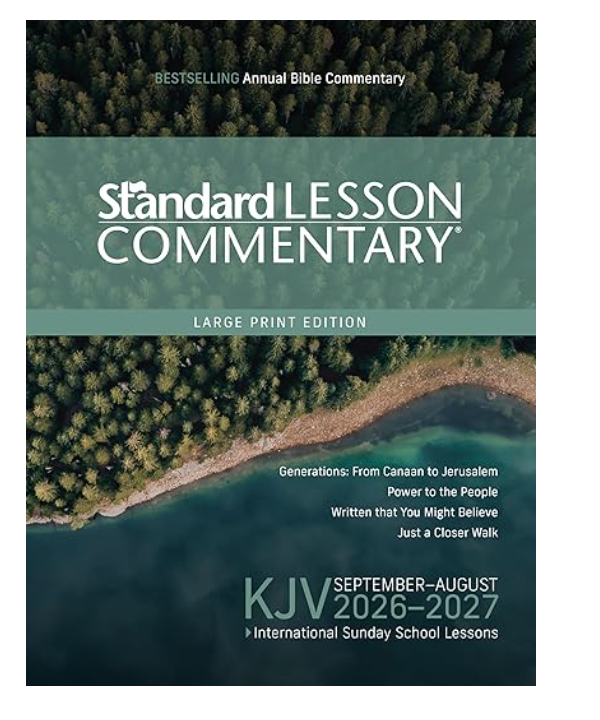
KJV Standard Lesson Commentary® 2026–2027 (Large Print)
The world's most popular annual Bible commentary, trusted for 60+ years. Printed KJV text, verse-by-verse notes, historical context, discussion questions, and group activities — 14pt large print.
Affiliate — we may earn from qualifying purchases at no cost to you.
Read the full chapter, then discuss it with a Faith Common group.
Read John 3 and join the conversationMore: all guides, free tools, verse of the day, or search the site.